Sunday, September 23, 2018

U.S. Border Patrol Official Says Canadian Pot Users Face Lifetime Ban


U.S. BORDER PATROL OFFICIAL SAYS CANADIAN POT USERS FACE LIFETIME BAN


As Canada prepares to legalize marijuana on Oct. 17, a U.S. official has warned that Canadians involved in the cannabis industry could face a lifetime ban from entering the country.

While some U.S. states and cities have loosened restrictions on or have legalized marijuana, the Border Patrol considers the drug an illegal substance and will classify those who work in the marijuana industry as drug traffickers. Todd Owen, executive assistant commissioner for the Office of Field Operations at the U.S. Customs and Border Patrol, told Politico on Thursday that investors in the pot industry will be banned as well. “If you work for the industry, that is grounds for inadmissibility,” he said.
Owen added that those who have invested in the industry in other countries, including Israel, have also been barred.
“We don’t recognize that as a legal business,” he said.
If people trying to cross the border from Canada say that they have used marijuana, they could be denied entry to the U.S., Owen noted. They can then apply for a waiver on the lifetime ban, which costs $585.
“Our officers are not going to be asking everyone whether they have used marijuana, but if other questions lead there—or if there is a smell coming from the car, they might ask,” Owen said. “If you lie about [use], that’s fraud and misrepresentation, which carries a lifetime ban.”
Under longstanding federal law, border officials can deny entry to or impose a lifetime ban on anyone who has illegal drugs or even admits past use of illegal drugs. Canadian Sen. Pierre-Hugues Boisvenu told Mother Jones that U.S. border officials said they would “increase the control” at border crossings.
In 2013, Jessica Goldstein became one of several Canadians banned from the U.S. for admitting to smoking pot.
“She [the border patrol agent] asked how many times I’d smoked pot in my life. I didn’t know the exact number; probably around 500 times,” Goldstein said. “Then she gave me a paper saying I was inadmissible to the U.S. and that I can’t cross unless I get a waiver. They turned us around and we had to drive back.”
In the U.S., 30 states, including Washington, Vermont, Alaska and Maine, have legalized or loosened restrictions on marijuana.

Wednesday, September 19, 2018

He couldn't afford insurance or insulin meds, and he died. His mom is speaking out


He couldn't afford insurance or insulin meds, and he died. His mom is speaking out


Alec Raeshawn Smith was on his parents' health insurance plan until he turned 26 last spring.
Smith had aged out of it, and he became uninsured. He tried rationing his insulin medication, because, as his mother later told the Star Tribune, he couldn't afford his own insurance and couldn't cover the $1,300 insulin refill. He didn't tell anyone of his struggle, the newspaper reported.
A little more than a month after his birthday, Smith died alone in his apartment. In lieu of flowers, family members asked that donations be given to the Juvenile Diabetes Research Foundation. An obituary said he had been studying to become a paramedic.
An autopsy showed Smith died of diabetic ketoacidosis because he was without his medication, KARE reported.
Now, his mother, Nicole Smith-Holt, is calling for lower insulin costs. She also told Minnesota Public Radio she wants to see laws holding pharmaceutical companies accountable.
Facebook photos showed Smith-Holt at a May 12 rally outside the Minnesota State Capitol, where she shared her son's story.
"It's heartbreaking. I should be with my son. I should not have had to bury him at such a young age. No parent should have to bury their children," Smith-Holt told KARE in an interview.
According to the American Diabetes Association, an estimated 7.5 million Americans depend on insulin. Citing 2016 research from the University of Melbourne, the organization said the average price of insulin almost tripled from 2002 to 2013.
"The rising cost of and access to insulin ultimately impacts everyone and especially people with diabetes and their families, health care providers, insurers and employers," the American Diabetes Association said in a statement. "Current estimates project that diabetes is the most expensive chronic illness in the U.S. at a total of more than $327 billion per year, including $15 billion for insulin."
Eli Lilly and Co., a global manufacturer of prescription drugs, told the Star Tribune they agreed drugs like insulin medication should be made accessible to all, but pushed back in placing the blame on manufacturers for rising drug prices.
"The price of insulin has gone up over 1,200 percent in 20 years," Smith-Holt told the newspaper. “It’s not affordable. You’re price-gouging people who need this one product to live, to survive."

Duration 1:52
What patients need to know about diabetes and heat
When the weather heats up, so does your risk of heat-related health issues—dehydration, heat exhaustion or heat stroke. Paying attention to the heat is especially important if you have a chronic illness such as diabetes. Here's what diabetics need

Tuesday, September 18, 2018

HOW STRUGGLING DAYTON, OHIO, REVEALS THE CHASM AMONG AMERICAN CITIES


An abandoned factory stands behind a barbed wire fence in Dayton, Ohio. (Ty Wright for ProPublica)


HOW STRUGGLING DAYTON, OHIO, REVEALS THE CHASM AMONG AMERICAN CITIES

By Alec MacGillis, Propublica.org

As A ProPublica/Frontline Documentary Shows, The Economic And Social Gaps Among Cities Are Growing As Dramatic As The Gaps Between Urban And Rural Areas.

“Left Behind America,” a ProPublica/Frontline collaboration, premieres on PBS on Sept. 11 and can also be streamed.
The news this past year has been full of the tribulations facing the cities at the vanguard of the great urban rebirth. There are fights over Uber limits in New York, cash-free purchasing in Washington, D.C., and extreme housing costs in San Francisco.
Dayton, Ohio, has been grappling with a different set of concerns. For example, there was a spate of disturbing, unexplained deaths in a formerly middle-class neighborhood just northwest of downtown. Over the span of seven months, five women’s bodies were found scattered around the area, at least three of them the victims of homicides, the others likely dead by overdose. Three had gone undiscovered for so long that they’d been partly eaten by animals. The deaths, and their aftermath, seemed to capture three of the city’s pathologies — violence, drug abuse and abandonment — inside an area of little more than a few square blocks.
The plight of small and mid-sized post-industrial cities like Dayton is hardly new, but it’s gotten obscured in recent years. The 2016 election drew a lot of attention to the urban-rural divide — between vibrant blue islands and fading red expanses that turned out so strongly for Donald Trump. What all the talk of the urban-rural gap overlooks is the growing divide among cities, too.
There have always been more and less wealthy cities, but nothing like what is on display today, as a select group of hyper-prosperous cities put ever-greater distance between themselves and their counterparts. Consider this. In 1980, even after the first wave of deindustrialization, Middle American cities such as Dayton were remarkably close to par with their coastal peers. Per capita income in the Seattle area was only 16 percent greater than in the Dayton area. In metro Boston, the edge was only 6 percent. In New York, 14 percent. In Washington, 31 percent. And in the San Francisco Bay Area, 33 percent.
All those cities have since left Dayton in the dust. Seattle’s per capita income is now 48 percent greater. Boston’s edge has jumped all the way to 61 percent — a tenfold increase. New York and Washington are both over 50 percent greater. And in the Bay Area, per capita income is 94 percent greater than in the Dayton area—that is, almost double. (And these stats are for the whole Dayton area, not just the diminished city proper, which has lost nearly half its population since 1960, to about 140,000 today, and where more than a third of the population now lives in poverty.) You’ll find similarly widening gaps if you substitute Dayton with St. Louis or Milwaukee or Fresno or Buffalo.
You hardly need income data, though, to discern these divides. Just use your own eyes. Take, for instance, the increasingly stark contrast between Washington, D.C., and Baltimore, where I live. A few decades ago, the cities were strikingly similar in their scale, levels of wealth and urban challenges — in fact, Baltimore’s population was 150,000 larger than D.C.’s as recently as 1980.
Today, to travel the 40 miles between the two cities is to risk vertigo, so wildly disparate have they become in cost of living, income levels and growth trajectory. Baltimore is laboring to demolish thousands of late-19th century townhouses that would each fetch close to seven figures in many parts of D.C. Last year, a single Realtor in D.C. sold five homes for more than $3.7 million each, more than any home sold in Baltimore that year. Maryland Gov. Larry Hogan in 2015 approved an expansion of the Washington Metro while killing a new rail line for Baltimore’s paltry transit system, furthering the divide.
You might expect regional inequality to self-correct, given how costly and congested the hyper-prosperous cities have become. Instead, the success of these cities feeds on itself, as more employers and highly educated people decide they need to be where the action is. It’s a winner-take-all, rich-get-richer effect. The result is less than ideal for everyone: Those in the winner-take-all cities struggle to get by even with a decent salary, while those in the left-behind cities face demoralizing blight and struggle to find fulfilling work.
This is the exact opposite of what was supposed to happen in the digital age. The internet was supposed to free us to live anywhere. But as Berkeley economist Enrico Moretti foresaw in his 2011 book, “The New Geography of Jobs,” the tech economy in fact encourages agglomeration: Innovation happens best in close proximity, not to mention that it’s easier to make your venture-capital pitch face to face. “It is almost as if, starting in the 1980s, the American economy bifurcated,” Moretti wrote. “On one side, cities with little human capital and traditional economies started experiencing diminishing returns and stiff competition from abroad. On the other, cities rich in human capital and economies based on knowledge-intensive sectors started seeing increasing returns and took full advantage of globalized markets.”
The irony for Dayton is that it knows the value of innovation clusters as well as anywhere. In the early decades of the last century, the city was home not only to the Wright brothers, but to lesser known inventors like Charles Kettering, who is credited with the electrical starting motor, among many automotive advances. The difference in the industrial age was that the manufacturing that flowed from those advances could be done just about anywhere with manpower, raw materials and transportation access. Today, manufacturing is typically done overseas, while the wealth accumulates in the hub cities where the intellectual property originated.
Economic concentration also plays a role in how the tech economy fuels regional inequality. As certain industries become dominated by certain companies — think of Google and Facebook’s growing share of ad revenue, or Amazon’s growing share of retail — it follows that more and more wealth flows to the places where those companies are based: the Bay Area and Seattle.
Social factors play a role, too. Since workers are less likely to spend their careers with one employer, they’re more likely to seek out a city where they can easily find a new job in their field if one doesn’t work out. You’re more likely to take a biotech job in Boston than that one intriguing option in Rochester. The rise of the two-income professional couple exacerbates this; you understandably want to be somewhere where both of you can find good jobs. Then there’s the growing tendency of well-off people to live amongst themselves, rather than in more mixed-income places, which increasingly concentrates them not only in certain neighborhoods, but certain metro areas. Call it the Brookline or Bethesda effect: seeking security in the comfort of excellent schools full of the children of fellow highly educated achievers.
People walk through the streets in downtown Dayton, Ohio. (Ty Wright for ProPublica)

The regional inequality is most glaring when it comes to the hyper-prosperous coastal enclaves, but it plays out within the interior, as well. Optimists about Middle America like to point to a handful of non-coastal cities that are thriving, without noting the many nearby cities being left behind. You hear a lot about Nashville, but less about Memphis; a lot about Columbus, but less about Akron and Toledo. As a recent report by the Greater Ohio Policy Center found, Columbus, which was from its founding less reliant on manufacturing than other Ohio cities, has in recent years “diverged dramatically” from other cities in the state on a whole range of economic measures, including population growth, poverty rates, labor force participation, and median income. More often than not, these regional winners are home to state capitals and major public universities: talented students head there for college, and don’t come back.
Too often, talk about left-behind regions is met by eye-rolling from cosmopolitans who view it as yet another attempt to summon sympathy for woebegone Trump voters. But this betrays a misreading of who lives in these struggling cities. Yes, they’re home to white working-class Obama-Trump voters. They’re also each home to tens of thousands of African-Americans, many of whom voted for Hillary Clinton, and many others of whom stayed home, seeing nothing on offer to address their plight. (Dayton proper is 40 percent black.) It was the combination of these voting blocs that explained Clinton’s losses in Midwestern states—not just voters turning to Trump, but Democrats in Milwaukee and Detroit and Cleveland who stayed home or voted third party.
Nan Whaley, the mayor of Dayton, joked darkly in a recent interview with me about how it took the 2016 election to draw notice to the plight of Middle America. “I mean, like look, I think the coastals need to pay attention to this because we can destroy elections,” she said. “You know, that’s what we can do, and I mean, then we get your attention.” Regardless of the cause, the growing regional disparities are starting to get overdue scrutiny from at least some in the upper echelons. Earlier this year, Larry Summers, the former treasury secretary, co-authored a big paper with Harvard colleagues Benjamin Austin and Edward Glaeser titled “Saving the Heartland,” which makes the case for place-based policies such as increasing wage subsidies like the Earned Income Tax Credit in struggling areas. The problem has also attracted AOL co-founder Steve Case, who, with “Hillbilly Elegy” author J.D. Vance, has been trying to draw more venture capital to Middle America.
For now, though, these cities are forging ahead on their own. For Dayton, that has meant, among other things, trying to make itself welcoming to immigrants and refugees. This effort has succeeded in one regard: The city has drawn hundreds of Ahiska Turks, an ethnic Turkish minority who were persecuted in Russia and former Soviet republics and briefly granted refugee status last decade. The Ahiska Turks have prospered in the trucking industry — their luxury cars are a familiar sight around Dayton — and they have renovated countless formerly vacant homes on the north side. As Islom Shakhbandarov, a community leader who co-owns a trucking company called American Power, put it to me with a knowing smile as he sat behind his big executive desk: “I see the opportunity, because it was almost empty — and there was room to fill it.” But this solution only goes so far for struggling cities at a time when the Trump administration is sharply curtailing refugee admissions, especially when it comes to Muslim refugees such as the Ahiska Turks.
Cities like Dayton are also embracing job growth of a sort that not so long ago would have been considered beneath them. The vast GM plant just south of the city that shut down in 2008 is now home to a Chinese-owned auto glass company called Fuyao. It employs more than 2,000, which helps explain why the unemployment rate in the Dayton area is back to pre-recession levels. But Fuyao pays much less than GM did. Wages start at about $15, and the work is grueling; an employee was crushed to death in March.
Cho Tak Wong, chairman of the Fuyao Group, speaks during the grand opening of the Fuyao Glass America plant in Moraine, Ohio, in 2016. The glass plant pays much less than GM did before it shut down in 2008.(John Minchillo/AP Photo)
When I asked Cho Tak Wong, the billionaire founder and CEO of Fuyao, about the wages, he objected to the premise of my question. The proper comparison, he said, was not to what people used to make in Dayton, but to wages in Mexico and China, by which yardstick Fuyao’s pay in Dayton looked okay. “Old GM workers are very thankful towards us, because they lost their jobs after the closure,” he said. “They are very happy since we came and offered them jobs.”
In fact, happiness is an emotion on scant display in Dayton these days. The city has been one of the hardest hit by the opioid epidemic: nearly 400 people died of fatal overdoses in Montgomery County, which includes Dayton, in just the first half of last year, eclipsing the county’s total for the entire year prior. Montgomery County Coroner Kent Harshbarger has deployed refrigerator truck back-ups usually reserved for mass fatality events. The overdose rate abated slightly over the second half of the year, as the fentanyl strains in the local heroin supply weakened. That drop-off sadly did not happen in Baltimore, which ended 2017 with a stunning tally of 761 fatal overdoses.
For all the talk about the opioid epidemic leaving few places untouched, the fact is that it’s hit far harder in struggling cities than in winner-take-all ones. And once the struggling cities become known as thriving markets for illegal opiates, they draw ever more addicts from nearby towns and suburbs, who avail themselves both of the drug supply and of local social services: shelters, soup kitchens, and drug treatment programs that aren’t available in the communities from which they’ve come. It’s a dark inversion of the winner-take-all dynamic in prosperous cities: instead of drawing ever more wealthy professionals, the struggling cities draw ever more people in desperate straits.
Judging by the opioid epidemic stats alone, these cities come across as awfully bleak. Nonetheless, I’ve developed a strong fondness for them—not just a fondness, but a preference for them over the winner-take-all cities. They are vastly more affordable, making possible a more expansive, less stressed existence; they are places where, thanks to their high need and smaller scale, one committed person or family can make a real difference.
A mural on the side of an old market on Third Street in Dayton (Ty Wright for ProPublica)
And they offer countless offbeat discoveries of the sort one is less likely to find in glossier environs. One evening in Dayton — at the end of a day when I observed a harrowing autopsy at the coroner’s office of a 45-year-old woman who had suffered a drug overdose — I stumbled upon a chess club inside an abandoned retail building downtown with a beautiful terra-cotta façade. There, I played a couple close games against a local community college student, and then wound up having dinner in a friendly tavern that turns out to be one of just two cooperatively owned brewpubs in the country. Naturally, I bought a share.
But the fates of these cities can’t depend on just the predilections of this or that new arrival with a soft spot for the underdog. The country must decide what it’s willing to do to narrow the regional gaps, from tackling economic concentration to targeting public investment. For some time, there’s been a growing awareness of the problem in having so much wealth concentrated in such a narrow slice of the income ladder. It’s now worth also considering what it means to have so much wealth concentrated in a narrow slice of cities.

Demonization of Russia in a New Cold War Era

New Cold War Era

In examining the future, we must look to the past.

As we watch the media today, we are spoon fed more and more propaganda and fear of the unknown, that we should be afraid of the unknown and have full faith that our government is keeping us safe from the unknown. But by looking at media today, those of us who are old enough will be reminded of the era of Cold War news articles, hysteria of how the Russians would invade and how we should duck and cover under tables in our kitchens for the ensuing nuclear war.
Under this mass hysteria all Western governments were convinced that we should join Western allies to fight the unknown evil that lies to the east. Later through my travels in Russia during the height of the Cold War with a peace delegation, we were shocked by the poverty of the country, and questioned how we ever were led to believe that Russia was a force to be afraid of. We talked to the Russian students who were dismayed by their absolute poverty and showed anger against NATO for leading their country into an arms race that they could not win.
Many years later, when speaking to young Americans in the US, I was in disbelief about the fear the students had of Russia and their talk of invasion. This is a good example of how the unknown can cause a deep rooted paranoia when manipulated by the right powers.

Inventing a foe to sell military ambitions is still the most dangerous of games.

All military is expensive, and we can see in Europe that the countries are reluctant to expand their military spending and find it hard to justify this to their people. In looking at this scenario, we can ask ourselves what is beneficial about this hysteria and fear caused on both sides.
All armies must have an enemy to deem them necessary. An enemy must be created, and the people must be convinced that there is need for action to safeguard the freedom of their country.
Right now, we can see a shifting of financial power from old Western powers to the rise of the Middle East and Asia. Do we honestly believe that the Western allies are going to give up their power? My suggestion is: not easily. The old dying empires will fight tooth and nail to protect their financial interests such as the petrol dollar and the many benefits that come through their power over poverty-stricken countries.
Firstly, I must say, that I personally believe that Russia is not by any means without faults. But the amount of anti-Russian propaganda in our media today is a throwback to the Cold War era. We must ask the question: Is this leading to more arms, a bigger NATO? Possibly to challenge large powers in the Middle East and Asia, as we see the US approaching the South China seas, and NATO Naval games taking place in the Black Sea.
Missile compounds are being erected in Romania, Poland and other ex-Soviet countries, while military games are set up in Scandinavia close to the Russian border to practice for a cold climate war scenario. At the same time, we see the US President arriving in Europe asking for increased military spending. At the same time the USA has increased its budget by 300 billion in one year.
The demonization of Russia is, I believe, one of the most dangerous things that is happening in our world today. The scapegoating of Russia is an inexcusable game that the West is indulging in. It is time for political leaders and each individual to move us back from the brink of catastrophe to begin to build relationships with our Russian brothers and sisters.
Too long has the elite financially gained from war while millions are moved into poverty and desperation. The people of the world have been subjected to war propaganda based on lies and misinformation and we have seen the results of invasions and occupations by NATO disguised as “humanitarian intervention” and “right to protect”.
NATO has destroyed the lives of millions of people and purposely devastated their lands, causing the exodus of millions of refugees. The people around the world must not be misled yet again.
I personally believe that the US, the UK and France are the most military minded countries, whose inability to use their imagination and creativity to solve conflict through dialogue and negotiation is astonishing to myself and many people. In a highly militarized, dangerous world it is important we start to humanize each other and find ways of cooperation, and build fraternity amongst the nations.
The policies of demonization of political leaders as a means of preparing the way for invasions and wars must be stopped immediately and serious effort put in to the building of relationships across the world. The isolation and marginalization of countries will only lead to extremism, fundamentalism and violence.
During our visit to Moscow we had the pleasure of attending a celebration of mass at the main Orthodox Cathedral. I was very inspired by the deep spirituality and faith of the people as they sang the entire three-hour mass. I was moved by the culture of the Russian people and I could feel that their tremendous history of suffering and persecution gave them sensitivity and passion for peace.
Surely it is time that we in Europe refuse to be put in a position where we are forced to choose between our Russian and American brothers and sisters. The enormous problems that we are faced with, such as, due to climate change and wars, mass migration and movement of peoples around the world, need to be tackled as a world community. The lifting of sanctions against Russia and the setting up of programs of cooperation will help build friendships amongst the nations.
Icall on all people to encourage their political leaders in the US, EU and Russia to show vision and political leadership and use their skills to build trust and work for peace and nonviolence.
Máiread Maguire
Máiread Maguire (www.peacepeople.com) was awarded the 1976 Nobel Peace Prize for her work to help end the “Troubles” in Northern Ireland. Her fierce activism has continued in numerous global causes serving the cause of peace.

Major Attack on Syria Approaching?


PETER FORD, peterford14 at yahoo.com

Ford was the U.K.’s ambassador in Syria and Bahrain before joining the United Nations to work on refugee issues. He is the co-chairman of the British Syrian Society. He recently wrote the piece “Is a Syrian Suez approaching?

Ford recalls the Suez crisis: “The plan was for France, soon joined by the U.K., to invade Egypt on the pretext of safeguarding the Suez Canal, in hopes of precipitating the overthrow of President Gamal Abdel Nasser. The Tripartite Aggression, as the Arabs call it, was duly triggered on 29 October 1956, when Israel invaded.”

He warns that a similar plan may be unfolding in Syria: “September 2018 is likely to witness another tripartite aggression based on pretexts and plotting, this time involving the U.S. alongside the U.K. and France. The victim now is Syria.

“The three governments in April staged a rehearsal for the upcoming performance, responding with bombing raids to the alleged use of chemical weapons in Douma. While Plan A for the raids involved heavy attacks on presidential offices and armed forces command and control centers, President Donald Trump was reportedly talked down from this by Secretary of Defense James Mattis, concerned by the prospect of possible clashes with Russia and risks to U.S. forces stationed in Syria.

“Aspects of the Douma operation conspired to make it likely that Plan A would be given a fresh run, which is now imminent. …

“It is not necessary to rehash the mountain of evidence pointing to the probability that Douma was fabricated. Suffice to say that OPCW [Organisation for the Prohibition of Chemical Weapons] inspectors, in their interim report presented on 6 July, stated that they had found no evidence that chemical weapons such as nerve agents had been used, and that the evidence for the use of chlorine as a weapon was inconclusive. …

“Were there any doubt that skulduggery was afoot, it was removed by media reports, based on Russian statements and briefings, of the White Helmets being on maneuver in the vicinity of Jisr al-Shughur, and the transfer to a nearby village of canisters of chlorine, under the direction of English-speaking special forces or contractors.

“Simultaneously, reports appeared of the U.S. bolstering its naval presence in the Gulf and land forces in Iraq on the borders with Syria. Russia has moved more of its naval forces into Syrian territorial waters in response to the warning of imminent action, say reports.

“How could anybody be so credulous as to believe a conspiracy theory like this, and from such tainted sources? Was it for a moment believable that the British or the Americans could be so duplicitous as to create for themselves a pretext to bomb a weak country in the Middle East? No need to go back as far as Suez to answer that; a quick recap of events in Iraq (weapons of mass destruction again) and Libya (baselessly alleged imminent massacres in Benghazi) would suffice.”

Sunday, September 16, 2018

Got Fascism?


During Gas Emergency, Mass. State Police Reveal They're Keeping Tabs On Activist Groups

by  

On Thursday evening, the Massachusetts State Police took to social media to share the extent of the gas emergency spreading across the Merrimack Valley.
But in so doing, they also shared the bookmarks bar at the top of the browser window — with some surprising entries.
The bookmarks raised more than a few eyebrows on Twitter, since they included the virtual meeting-places of several activist groups. Some activists felt it offered proof the police conduct unwarranted surveillance, particularly of organizations on the political left.
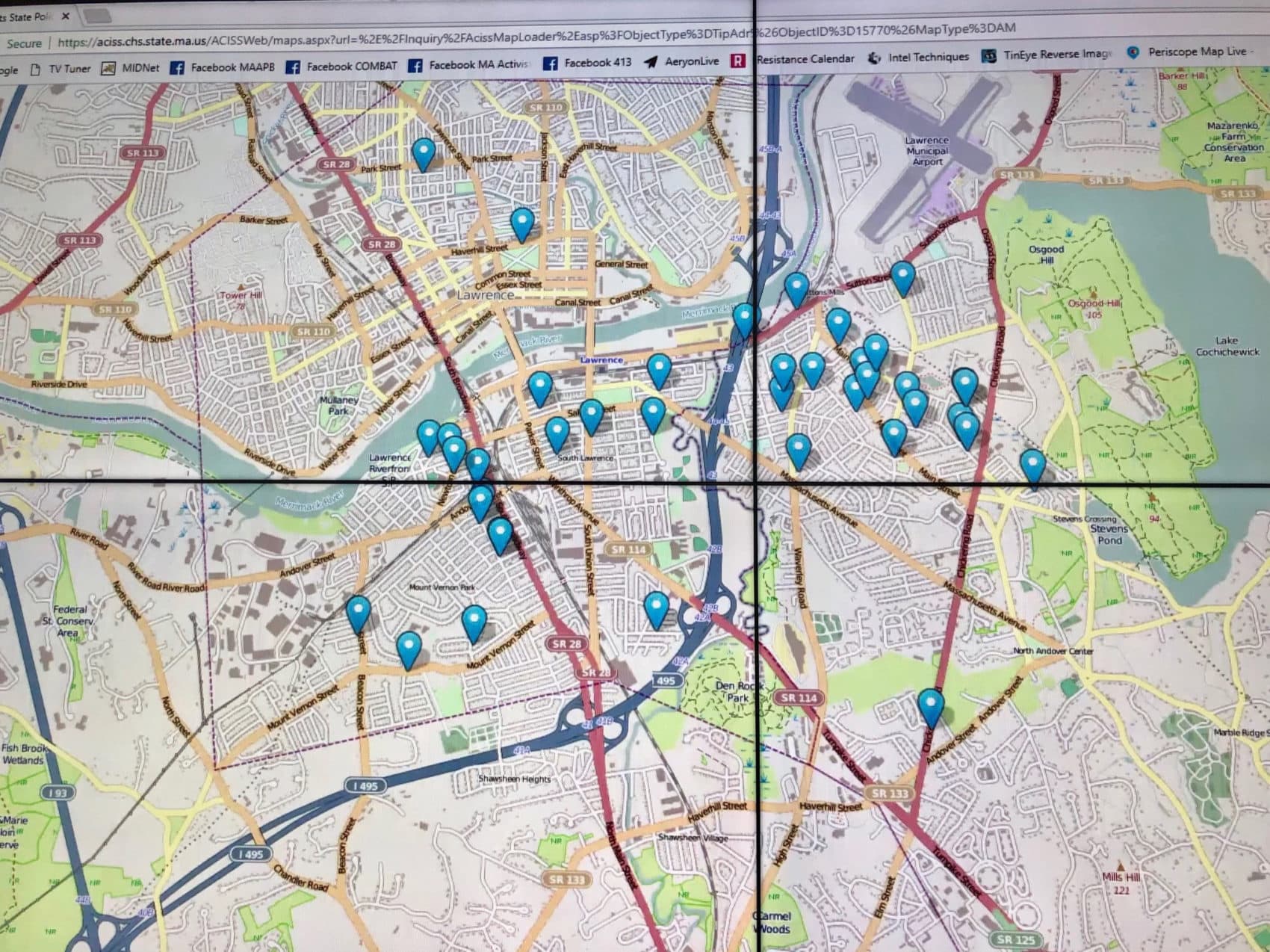
At 6:26 p.m., the state police's official Twitter account shared an image of a computer monitor showing the locations of 39 fires and explosions.
A screenshot of a now-deleted tweet from Mass. State Police, depicting confirmed fires and explosions in the Lawrence/Andover/North Andover area.
But whoever posted the image forgot to use a "crop" tool. So the image included the browser's bookmarked links, including several sites run by left-wing activist groups.
A closer-up look at a map tweeted out by Mass. State Police, inadvertently revealing bookmarks on the browser.
Among them were the Facebook groups for Mass. Action Against Police Brutality (MAAPB), which organizes protests and reposts stories of Americans killed by police; the Coalition to Organize and Mobilize Boston Against Trump (COMBAT); and other activist organizations. The "Resistance Calendar," which shares upcoming anti-Trump protests in Boston and nationwide, was also bookmarked.
State police deleted that first tweet, and another image they shared an hour later was cropped. But some shared screenshots of the original, suggesting the saved sites were evidence of unreasonable police attention focused on political speech.
In a statement, state police did not deny that they bookmarked these pages for monitoring, saying they have a responsibility to prepare for "all large, public gatherings."
The statement continued: "We, obviously, need to know if large numbers of people, for whatever reason, are going to be on public roadways or public spaces, so that we may ensure the safety and rights of those who have gathered as well as of the members of the public around them."
But some aren't satisfied with that argument.
"I wasn't surprised — but I was appalled," said Kade Crockford, director of the Technology for Liberty program at the Massachusetts branch of the ACLU. "American law enforcement has, for a very long time, targeted dissidents. A lot of people like to believe those tactics ended. But that's not true — and actually, after 9/11, they've seen a substantial resurgence."
Crockford observed that the second map tweet from the state police's account mentioned it was taken at the Commonwealth Fusion Center, an information-gathering nerve center in Maynard.
That center opened in 2005 under Gov. Mitt Romney, with the stated aim of improving the state’s "ability to fight crime and terrorism by analyzing data from a variety of sources."
Crockford said these institutions of "intelligence-led policing" have shown little success in preventing terrorist violence. "But what they have done, unfortunately, is marshal their substantial resources ... to keep track of the activities of perfectly law-abiding organizations that are expressing their First Amendment rights to organize and protest."
2015 ACLU report found that the state's other fusion center, the Boston Regional Intelligence Center, or BRIC, prepared intelligence reports on antiwar activists and elected officials.
Crockford pointed to a 2012 Senate subcommittee report that found that fusion centers hadn't contributed to federal counterterrorism efforts and that they generated intelligence "of uneven quality — oftentimes shoddy, rarely timely, sometimes endangering citizens' civil liberties... and more often than not unrelated to terrorism."
Leaders from the affected groups did not respond immediately to requests for comment.
But it's worth noting that COMBAT and MAAPB are both small organizations, with fewer than 10,000 "likes" between them. Neither page lists any forthcoming events, and COMBAT has not published anything on its Facebook page since last November.
The state police statement pushed back on any claim of bias, saying, "We do not collect information about — nor, frankly, do we care about — any group’s beliefs or opinions." It called this kind of monitoring "a common – and common-sense – a function of any police department."

http://www.wbur.org/news/2018/09/14/during-gas-emergency-mass-state-police-reveal-theyre-keeping-tabs-on-activist-groups