Showing posts with label Anti-War. Show all posts

Saturday, August 8, 2020

With survival at stake, can weapons makers change course?


by Kathy Kelly
Pax Christi USA Teacher of Peace

Today, the seventy-fifth anniversary of the atomic attack on Hiroshima, should be a day for quiet introspection. I recall a summer morning following the U.S. 2003 “Shock and Awe” invasion of Iraq when the segment of the Chicago River flowing past the headquarters of the world’s second largest defense contractor, Boeing, turned the rich, red color of blood. At the water’s edge, Chicago activists, long accustomed to the river being dyed green on St. Patrick’s Day turned the river red to symbolize the bloodshed caused by Boeing products. On the bridge outside of Boeing’s entrance, activists held placards urging Boeing to stop making weapons.

This summer, orders for Boeing’s commercial jets have cratered during the pandemic, but the company’s revenue from weapon-making contracts remains steady. David Calhoun, Boeing’s CEO, recently expressed confidence the U.S. government will support defense industries no matter who occupies the Oval Office. Both presidential candidates appear “globally oriented,” he said, “and interested in the defense of our country.”

Investors should ask how Boeing’s contract to deliver 1,000 SLAM- ER weapons (Standoff Land Attack Missiles-Expanded Response) to the Kingdom of Saudi Arabia “defends” the United States.

Here are excerpts from Jeffrey Stern’s account of a missile’s impact on the town of Arhab in a remote area of Yemen. In this case, the missile was manufactured by Raytheon:

Now, as Fahd walked into the hut, a weapon about the length of a compact car was wobbling gracelessly down through the air toward him, losing altitude and unspooling an arming wire that connected it to the jet until, once it had extended a few feet, the wire ran out and ripped from the bomb.

Then it was as if the weapon woke up. A thermal battery was activated. Three fins on the rear extended all the way and locked in place. The bomb stabilized in the air. A guidance-control unit on the nose locked onto a laser reflection — invisible to the naked eye but meaningful to the bomb — sparkling on the rocks Fahd walked over.

At the well, at the moment of impact, a series of events happened almost instantaneously. The nose of the weapon hit rock, tripping a fuse in its tail section that detonated the equivalent of 200 pounds of TNT. When a bomb like this explodes, the shell fractures into several thousand pieces, becoming a jigsaw puzzle of steel shards flying through the air at up to eight times the speed of sound. Steel moving that fast doesn’t just kill people; it rearranges them. It removes appendages from torsos; it disassembles bodies and redistributes their parts.

Fahd had just stepped into the stone shelter and registered only a sudden brightness. He heard nothing. He was picked up, pierced with shrapnel, spun around and then slammed into the back wall, both of his arms shattering — the explosion so forceful that it excised seconds from his memory. Metal had bit into leg, trunk, jaw, eye; one piece entered his back and exited his chest, leaving a hole that air and liquid began to fill, collapsing his lungs. By the time he woke up, crumpled against stone, he was suffocating. Somehow he had survived, but he was killing himself with every breath, and he was bleeding badly. But he wasn’t even aware of any of these things, because his brain had been taken over by pain that seemed to come from another world.

In 2019, the UN Group of Eminent Experts on Yemen observed “the continued supply of weapons to parties involved in Yemen perpetuates the conflict and the suffering of the population.”

These experts say “the conduct of hostilities by the parties to the conflict, including by airstrikes and shelling, may amount to serious violations of international humanitarian law.”

A year and a half ago, were it not for a presidential veto, both houses of the U.S. Congress would have enacted a law banning weapons sales to Saudi Arabia.

Another end-user of Boeing’s weapons is the Israeli Defense Force.

The company has provided Israel with AH-64 Apache helicopters, F-15 fighter jetsHellfire missiles (produced with Lockheed Martin), MK-84 2000-lb bombs, MK-82 500-lb bombs, and Joint Direct Attack Munitions (JDAM) kits that turn bombs into “smart” GPS-equipped guided bombs. Boeing’s Harpoon sea-to-sea missile system is installed on the upgraded 4.5 Sa’ar missile ships of the Israeli Navy.

Apache helicopters, Hellfire and Harpoon missiles, JDAM guiding systems, and Dense Inert Metal Explosive (DIME) munitions have been used repeatedly in Israeli attacks on densely populated civilian areas, resulting in thousands of civilian casualties in Lebanon, the West Bank, and Gaza. The human rights community, including Human Rights Watch, Amnesty International, B’Tselem, and United Nations commissions, ruled these attacks to be human rights violations and at times war crimes.

I lived with a family, in Gaza, during the final days of the 2009 “Operation Cast Lead” bombing. Abu Yusuf, Umm Yusuf, and their two small children, Yusuf and Shahid, welcomed Audrey Stewart and me to stay with them. Once every 11 minutes from 11 p.m. – 1:00 a.m. and again from 3:00 a.m. – 6:00 a.m., we heard an ear-splitting blast. Normally, I wouldn’t have known the difference between the sound of a Hellfire Missile exploding and that of a 500 lb. bomb dropped from an F-15, but soon I could tell the difference. Little Yusuf and Shahid taught us to distinguish one gut-wrenching sound from the other. They had been cringing under the bombs for 18 days and nights.

I don’t see how the sale of weapons to governments which use them against civilian populations, against people like Fahad, in Arhab or Abu Yusuf and his family in Gaza, defends people in the U.S.

Boeing’s vast resources for scientific know-how, skillful engineering, and creative innovation could, however, help defend the U.S. against the greatest threat we  now face, environmental climate catastrophe. Writing for The New York Review of Books, Bill McKibben predicts “a century of crises, many of them more dangerous than what we’re living through right now.” The main question, he says, is whether human beings can hold the alarming rise in temperature “to a point where we can at great expense and suffering, deal with those crises coherently, or whether they will overwhelm the coping abilities of our civilization.”

“A rise of one degree doesn’t sound like an extraordinary change,” McKibben writes, “but it is: each second, the carbon and methane we’ve emitted trap heat equivalent to the explosion of three Hiroshima-sized bombs.”

Boeing’s engineers, scientists, designers and marketers could help turn  the tide of human actions destroying our earth. Their expertise could truly “defend” people.

There’s a lesson to be learned from the river flowing outside of Boeing’s headquarters. It actually flows backwards. Long ago, brilliant engineers designed a way for the river to reverse its course. In doing so, they saved Chicago from sewage contamination of its drinking water supply – Lake Michigan. This action was hailed as one of the great engineering wonders of the world.

The City’s sewers discharged human and industrial wastes directly to its rivers, which in turn flowed into the lake. A particularly heavy rainstorm in 1885 caused sewage to be flushed into the lake beyond the clean water intakes. The resulting typhoid, cholera, and dysentery epidemics killed an estimated 12 percent of Chicago’s 750,000 residents, and raised a public outcry to find a permanent solution to the city’s water supply and sewage disposal crisis.”

The Sanitary and Ship Canal was constructed at an estimated cost of over $70,000,000. After its completion, in 1900, waterborne disease rates quickly and dramatically improved, and its water supply system was soon regarded as being one of the safest in the world. With its water source made safe and dependable by the canals, Chicago and the region grew and prospered rapidly.

I don’t think it’s a good idea to dye the Chicago River, red or green. We need to protect the river and all wildlife dependent on it. But, we must continually confront Boeing and other weapon manufacturers, and insist they not destroy lives, homes and infrastructures in other lands. We must urge Boeing, like the river, to reverse course and participate, with dignity and humility, in the pursuit of human survival.

____________

POSTER CREDIT: ANOTHER MOTHER FOR PEACE, LORRAINE SCHNEIDER, 1966

Joint interfaith statement on the 75th anniversary of the atomic bombings of Hiroshima and Nagasaki

 AUGUST 6, 2020

NOTE: Pax Christi USA has joined nearly 200 other organizations in signing onto this statement to commemorate the 75th anniversaries of the bombings of Hiroshima and Nagasaki.

As a wide coalition of faith-based communities from around the world, we have committed to speaking with one voice that rejects the existential threat to humanity that nuclear weapons pose. We reaffirm that the presence of even one nuclear weapon violates the core principles of our different faith traditions and threatens the unimaginable destruction of everything we hold dear. Nuclear weapons are not only a future risk, their presence here and now undermines the ethical and moral foundations of the common good. We call for your commitment to a world that is more peaceful, safe, and just—a world only possible with the elimination of nuclear weapons.

August 2020 marks the 75th anniversary of the nuclear attacks on Hiroshima and Nagasaki—attacks which devastated these cities causing up to 213,000 deaths by the end of 1945 and many more in the following years. The attacks inflicted excruciating pain and suffering on both humans and the environment.

We are grateful for the global hibakusha, survivors, who have courageously borne witness, often in the face of intimidation and the recurring tragedy of loss and illness. We must meet the courage of the survivors with our own. We must abolish nuclear weapons forever.

We lament the racism and colonialism that drove the nuclear-weapon States to test their weapons on the communities that they deemed expendable, lives far away from their own, lives that mattered less, lives that were taken in pursuit of destructive power for a few. We acknowledge the immense suffering, oppression and exploitation faced by the Indigenous communities around the world whose bodies, lands, waters and air have served as the testing grounds for the ambitions of those who dominate with force.

Few who believe in the disingenuous notion of nuclear deterrence have witnessed or experienced the devastation of these weapons in their own communities. After seventy-five years we can see that nuclear weapons have not brought an end to war. Nuclear weapons do not create peace, rather they intensify the scourge and threat of war in our world, lives and communities. Because they are designed to cause massive and indiscriminate destruction, because they siphon precious resources that are needed to meet human needs and protect our shared planet, and because they enforce and sustain a global system based on domination and unending violence, the existence of nuclear weapons fundamentally contradicts the principles of any moral, religious and ethical system that values life.

Whilst many of our lives and imaginations might be far removed from memories of “hell on earth” and the legacies of environmental impacts, shattering health conditions and trauma wrought in a nuclear explosion, the impacts of the current global health crisis have given us all a glimpse into how life would change in the event of a nuclear explosion. Like the COVID-19 pandemic, the health, environmental and economic consequences would not be contained in space or time. Nuclear tests and accidents have revealed that radiation spreads through the atmosphere, oceans, plants, animals, and whole human populations. Our economies, production chains and ability to grow food would be severely disrupted.

Many have consigned the stories of the horrors of this time to our distant past—stories only to be revisited when certain leaders deem it necessary to remind their citizens what others might do to them if they give up their own nuclear capacities. But we will not forget or ignore the powerful witness of those affected by developing, testing and using nuclear weapons. We are committed to ending nuclear weapons forever to honor the global hibakusha and to save our children, grandchildren, and future generations from experiencing what they suffered. As we build a world where equality, peace and justice are abundant for all, there is no place for nuclear weapons in our shared future.

Despite commitments made—including under the Treaty on the Non-Proliferation of Nuclear Weapons (NPT)—nuclear-weapon States have continued to maintain and develop their nuclear arsenals, while other States have worked to acquire them.

Despite our clear-eyed awareness of the dangers of the present moment, we are united in our irrepressible belief that change for the good is possible—in individual lives and in our world. We know that in the most dangerous and threatening times, human beings are capable of cooperation, creative problem-solving and mutual trust. Indeed, the existence of the nuclear Non-Proliferation Treaty (NPT) itself reaffirms that hopefulness. The NPT was born out of a moment when fears about nuclear war and distrust were at a peak, and it acted as a beacon to remind nations that international collaboration was possible and that each nation’s security does not demand the insecurity of others, but rather is contingent upon the security of all. We find ourselves again in such a moment in which the reaffirmation of international norms and the embrace of the NPT’s ultimate promise—abolition—must be realized.

In 2017, this goal of abolition moved closer to becoming reality when the UN adopted the Treaty on the Prohibition of Nuclear Weapons, calling for the complete elimination of all nuclear weapons. Once 50 States have ratified it, it will enter into force. We urge our governments to use the opportunity of the 75th anniversary of the only occasion that nuclear weapons have been used in conflict, to ensure that they are never used again in any circumstances. We call upon all States to join the growing community of States which have rejected nuclear weapons entirely. We appeal to you to ratify the Treaty on the Prohibition of Nuclear Weapons.  

Click here to see a list of signatories.

Friday, August 31, 2018

PEACE ACTIVISTS BLOCK BOEING WEAPONS FACILITY WITH BUS TO PROTEST WAR ON YEMEN


PEACE ACTIVISTS BLOCK BOEING WEAPONS FACILITY WITH BUS TO PROTEST WAR ON YEMEN


RESIST!  
Peace activists in St. Charles, Missouri blocked the entrance to a weapons facility run by the arms manufacturer Boeing on Monday, August 27, in protest of the joint US-Saudi war on Yemen.
The anti-war demonstrators barricaded the street with a bus, on which they wrote “Boeing gains from Yemen’s pain.”
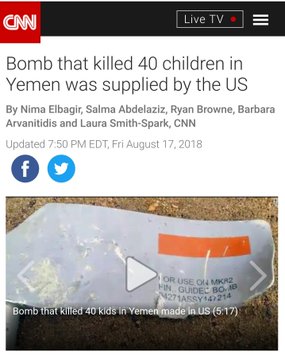
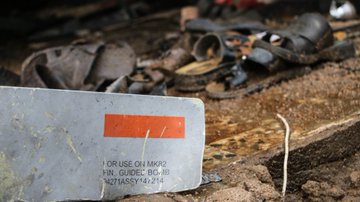
They used a bus as a symbol of Saudi Arabia’s August 9 bombing of a school bus in Yemen, in which at least 40 children and 11 adults were killed and another 79 civilians were wounded with a US-made bomb.
The Earth Defense Coalition said in a press release that the “action was done in solidarity with the people of Yemen as they are murdered by Saudi Arabia using weapons supplied by Boeing and other weapons manufacturers.”
The group noted that the St. Charles Boeing office manufactures “smart bomb” kits like those used by Saudi Arabia in Yemen.

The “lockdown” protest began at 6 am EST and lasted for more than five hours.
Phillip Flagg, one of the protesters on the bus, said in a statement:
To the people of Yemen I’d like to say that we have heard your cries and that you are not alone. On the contrary, it seems clear to me that both the Yemeni and American people share a common enemy in the United States government and the corporations that control it. The same corporate state that is responsible for your suffering in Yemen is responsible for our suffering from Flint to Ferguson to the bayous of Louisiana.
Activist Amber Mae said two protesters were arrested in the action and charged with obstructing and resisting and are being held on $600 cash bond. “One will post bail, the other has chosen to remain incarcerated awaiting time with a judge,” Mae said.
Heather De Mian, a citizen journalist who uses the handle @MissJupiter1957, livestreamed video footage and reported from the site of the protest:


De Mian said the police parked their cars around the bus to prevent reporters from filming it.


Protesters using a bus to block the entrance to the Boeing Plant in St Charles, MO.
I'm told there are protesters chained together & the bus represents the school bus bombed in Yemen.https://www.cnn.com/2018/08/17/middleeast/us-saudi-yemen-bus-strike-intl/index.html  pic.twitter.com/DzPBb3IkCb

View image on TwitterView image on TwitterView image on Twitter
The St Charles Police have decided to violate the First Amendment Freedom of the Press & have strategically parked their vehicles to prevent filming of their handling of the protesters.
cc @aclu_mo pic.twitter.com/JEqXDSSHPN

View image on TwitterView image on TwitterView image on Twitter

Yemeni journalist Ahmad Algohbary wrote in support of the protest, “As one of the Yemeni people, I express my deep gratitude for those activists for standing in solidarity with us and for blocking both entrances to Boeing Defense Building 598 in St. Charles facility today morning.”
“The bus represents the school bus crime by #US bomb in #Yemen,” Algohbary said.


View image on TwitterView image on TwitterView image on Twitter

As one of the Yemeni people, I express my deep gratitude for those activists for standing in solidarity with us and for blocking both entrances to Boeing Defense Building 598 in St. Charles facility today morning.
The bus represents the school bus crime by bomb in .

“Thank you so much, from Yemen, wrote journalist Nasser Morshid Arrabyee. “Yemen bus will remain spot of shame and disgrace on killers. Your bus will remain symbol of love in our debt.”