Monday, August 27, 2018

5 ways to take action against family detention


Communities across the country are continuing to organize and advocate against the Trump administration’s cruel "zero tolerance" policy for immigrants crossing the U.S.-Mexico border, including an executive order that directs the Department of Homeland Security to expand the detention of families and speed up their deportations. The order came amid public outrage over U.S. Customs and Border Protection (CBP) and Immigration and Customs Enforcement (ICE) separating children from their parents at the border.
It’s important to remember that Immigration and Customs Enforcement (ICE) and Customs and Border Protection (CBP) have a long history of separating families and terrorizing people fleeing poverty and violence—and it’s time to put an end to the cruelty and dehumanization of immigrants by these agencies. 
Here are 5 things you can do today to speak out against the Trump administration's inhumane immigration policies: 

1. Tell Congress to stop ICE and Border Patrol! 

Our elected officials need to hear from you today! Email your senators and representative, and tell them to stop using our taxpayer dollars for ICE and CBP.
And sign our petition urging Congress to take immediate steps to abolish ICE once and for all. 

2. Call your senators and members of Congress : 202-224-3121.

Phone calls are an effective way to get the attention of your elected officials. Call the Capitol switchboard at 202-224-3121 to look up your senators and representatives. Once you're connected, use our talking points below to let them know where you stand: 
  • As your constituent, I am appalled at the Trump administration's detention and deportation of families who come to our country seeking refuge.   
  • ICE and Customs and Border Protection have a long history of tearing apart families and terrorizing communities.
  • I urge you to stop funding these two agencies.
  • Please work for policies that respect the dignity and rights of all people. 

3. Urge your friends to take action on social media.

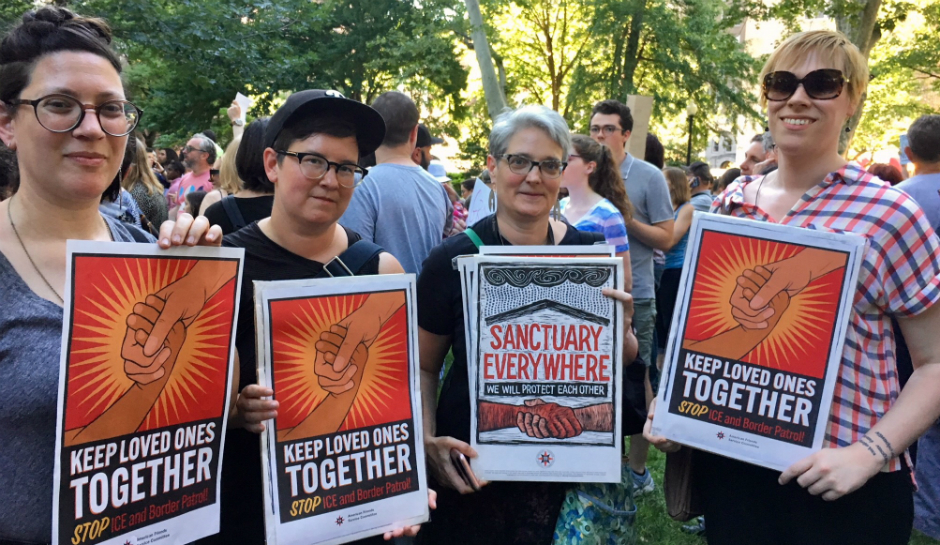
Share our graphic "Keep loved ones together. Stop ICE and Border Patrol" on Facebook or Twitter, and encourage your family and friends to speak out in this critical moment. You can also download graphics for social media here. 

4. Download and use our "Keep loved ones together" and "Abolish ICE" signs for protests and actions.

Join actions in your city to show strong support for stopping ICE and Border Patrol. Use these signs to broadcast a message to elected officials, the media, and your community.  

5. Support AFSC's work for immigrant rights.

In cities across the U.S., AFSC provides legal services to immigrants facing detention and deportation; offers know-your-rights trainings to community members; works with communities to document abuses by ICE and Border Patrol agents; and supports immigrants in organizing for policies that welcome and respect all people. Please help us continue this vital work by donating today.

To The Front Lines in Louisiana

Image may contain: one or more people, text and outdoor


To The Front Lines in Louisiana
"L'eau Est La Vie Camp-No Bayou Bridge"

Society of Native Nations is answering the call from our relatives in Louisiana and looking to head to the front lines of the”Energy Transfer Partners” fight out at the "L'eau Est La Vie Camp-No Bayou bridge" where they can really use help this LABOR DAY WEEKEND. We are asking all members, supporters, water protectors, land protectors, air and life protectors to please make your way out to the front lines this weekend.

If you can not make it physically, then please consider helping with travel expenses for those that are going.

US Denounces Human Rights


US Denounces Human Rights

Mark Maxey


“I want to make it crystal clear that this step is not a retreat from human rights commitments,” US Ambassador to the U.N. Nikki Haley, told the media. “On the contrary, we take this step because our commitment does not allow us to remain a part of a hypocritical and self-serving organization that makes a mockery of human rights.”
This was a joint statement made by Haley and Secretary of State Mike Pompeo, on why the United States was removing themselves from the UN Human Rights Council, in June 2018. The Council was established in 2006.
“Let me be crystal clear, the US has been, always been, an abuser of human rights. Their manifest destiny themed ideology has crucified, burned, and killed persons of color since 1776”, Mark Maxey, National Coordinator for Movement 4 People’s Democracy said.
Trump’s disastrous immigration policy of today reflects the same ideology that has been deployed as a weapon against Indigenous cultures from the 1600s to the present. He denounces immigrants as rapists, killers, and animals—implying they must all come from an inferior culture. When his supporters claim that detained children are better off in detention than they were with their parents, the belief in (white) American society’s superiority is on full display.
Early reformers used their religious beliefs to justify their Manifest Destiny perspective. It overflowed into Congress, which passed Manifest Destiny-themed bills. Indigenous people, meanwhile, were on the receiving end of this religious zealotry. Rape, abuse, kidnap, murder, and genocide were the end results for them. The recent quoting of Biblical scripture by Attorney General Jeff Sessions to justify the stealing of immigrant children from their parents shows that this ideology is still very much alive among at least some sectors of the U.S. government.
Capitalism is still playing into the mythology of white Manifest Destiny, which goes back to the earliest colonial settlements. Trump’s policies are aimed at stoking the racist anger and resentment of his mass base, but they reflect the interests of the same oligarchy that Sen. Bernie Sanders assailed in his bid for the presidency. In every way, the current administration’s policies show favoritism to those at the top and seek any way possible to divide those outside the ranks of the super-wealthy.
The US Congress, and the whole government is out of touch with reality. As it relates to Human Rights. “The UN Human Rights Council has always been a problem. Instead of focusing on real human rights issues, the council has used its time and resources to bully Israel and question Israel’s legitimacy as a sovereign state,” Rep. Eliot Engel, the ranking Democratic member of the House Committee on Foreign Affairs, said in a statement June 2018.. “But the way to deal with this challenge is to remain engaged and work with partners to push for change.
Screenshot 2018-08-25 at 4.59.06 PM
Let’s talk openly and honestly about Palestine and Israel. Just look at these images on how Israel has usurped and stolen land from the Palestinian people. Israel has used the same manifest destiny ideology to go above and beyond the UN agreement signed in 1947. No wonder the US is in agreement with Israel, just ask any Indigenous Nation with a Treaty signed by the US and not followed by the US.
The struggles of the Palestinian people is real. A heavy aura of Zionist oppression was felt when I was in Palestine in 2016. Ironic that in such a place where the human history of a love revolution from God took place, such chaos explodes across the pristine landscape.
In 1947 the boundaries set in agreement with the Jewish Nation and Palestine gave a well-defined area of ownership of land for the Palestinians. However, through the years Israel has encroached and usurped land illegally from the Palestinians. Presently the map reflects 75% less than given by the UN in 1947. “Let’s be honest, this present situation (Al-Aqsa) is about occupation,” Imam Imad Enchassi says. “The Palestinians desire their own recognized state. One man, one vote.”
Theodor Herzl, the father of political Zionism, outlined his vision for a Jewish state in his publication called Der Judenstaat(The Jewish State), published in February 1896.
Ralph Schoenman, in his book, The Hidden History of Zionism, says, “the objective of Zionism has never been merely to colonize Palestine – as was the goal of classical colonial and imperial movements during the 19th and 20th centuries. The design of European colonialism in Africa and Asia was, essentially, to exploit indigenous peoples as cheap labor while extracting natural resources for exorbitant profit.” You can read the full book online here. This ideology was set forth in 1896 by Herzl. It became reality in 1947. Taking 51 years of indoctrination to see the rise of this racist mentality become a government of oppression, Israel. I am not being anti-Semitic because Zionism is a nationalist mentality, not a race of persons nor a religion. Zionism again is no different than the current rise of alt-right nationalism under the Trump administration.
pasted image 0
AIDA Camp, Palestine, Memorializing the children massacred in July 2014 (photo by Mark Maxey)
pasted image 0 (1)
AIDA camp, Palestine, art graffiti on the WALL that separates Israel and Palestine (photo by Mark Maxey)

President Trumps heralds a new deal with relationships with Israel. Trumps administration clearly impedes upon the democracy Palestine seeks. It is preferential treatment against the victims (Palestine) from the oppression heavily used by the Israeli government.
While in Palestine (West Bank) June 2015 for two weeks I saw how Israel’s occupation impacts human rights for Palestinians. Israel controls their movement, right to travel, water supply, and the building of their homes. This heavy-handed oppression by Israel fuels the anger Palestinians have.  Many Palestinian Muslims approached me with smiles thanking me for coming. But they all said, “Please tell your government not to fund weapons used against us.” America gives Israel approximately 40 Billion dollars a year. The travel of any Palestinians is maniacally controlled by the IDF. Sometimes IDF holds Palestinians up to 12 hours to simply walk to Jerusalem (less than a mile) to purchase food.
I witnessed the IDF bring bulldozers inside Palestine, West Bank. The reason was stated no building permit was issued, while the Palestinian was waving his permit in the air. The Palestinians are defenseless against the martial law enforced by Israel. Palestinians are denied a nation and citizenship rights by the Zionist policies of the Israeli government.
“The council ceases to be worthy of its name,” US Ambassador to the U.N. Nikki Haley said, explaining the U.S. withdrawal. “Such a council, in fact, damages the cause of human rights.” What a line of bull manure that is. The US damages the cause of human rights daily.
Kenneth Roth, executive director of Human Rights Watch, said the U.S. focus on Israel’s treatment has actually caused American officials to lose sight of the good work the council has done elsewhere.
“The U.N. Human Rights Council has played an important role in such countries as North Korea, Syria, Myanmar and South Sudan, but all Trump seems to care about is defending Israel,” Roth said in a statement to NPR. “Like last time when the U.S. government stepped away from the Council for similar reasons, other governments will have to redouble their efforts to ensure the Council addresses the world’s most serious human rights problems.”
And Richard Gowan, a fellow at New York University’s Center on International Cooperation, told NPR’s Michele Kelemen that there is another potential issue muddying the waters of this decision: the recent condemnations leveled at the Trump administration’s immigration policies by international human-rights officials.
In a span of fewer than two months, U.S. officials have separated some 2,300 children from their parents after they crossed the border into the U.S., according to the Department of Homeland Security. And the administration’s policy has attracted a sharp rebuke from the U.N. high commissioner on human rights, Zeid Raad al-Hussein.
“The thought that any State would seek to deter parents by inflicting such abuse on children is unconscionable,” Raad al-Hussein said Monday, in comments opening the 38th session of the Human Rights Council.
Trump and his team’s “law and order” framework is the same one articulated by President Richard Nixon in the late 1960s and more subtly invoked by Presidents Ronald Reagan and Bill Clinton as they ramped up the drug war and fueled massive prison expansions during their times in office. We jail and separate families at the border to deter illegal immigration just as we jail and separate poor families within our country because they can’t afford bail or proper legal representation.
Simply put the US has always been a denier of Human Rights. Organizations such as Movement 4 People’s Democracy rallies support for true Human Rights. MPD brochure shows how they break through the chaff, the fascist walls of capitalism, and exposes the truth of Human Rights. The only reason the US left the UN Council for Human Rights, is because they are and support others that trample human rights.
Screenshot 2018-08-26 at 9.48.37 PM
x

Sunday, August 26, 2018

For Indigenous Peoples, Losing Land Can Mean Losing Lives


by , WRIJuly 26, 2018


Ten years ago, the Cambodian government granted 20,000 hectares (49,000 acres) of land to a Thai company to plant sugarcane. But this land was not empty.
Six hundred families were already living on it, growing rice and vegetables and foraging food and other goods from the nearby community forest. Over the next few years, the company cut down more than half the forest. While conducting evictions, staff and security forces looted rice fields and demolished or burned more than 300 homes. Many people lost their land and all their belongings. Parents sent their children to work in Thailand, unable to farm and afford school fees.

Villagers are trying to recover some of their losses through a class action lawsuit. But even if they are successful, it will provide little remedy for the felled forests, destroyed homes and disruption of community life.


This story is all too common to the 2.5 billion people living on indigenous and community lands. These lands, crucial for livelihoods, are protected under international human rights law and social and environmental standards: Indigenous Peoples may not be relocated from their land without their free, prior and informed consent, and customary and informal land rights should be respected. Many national laws also incorporate these principles. However, because many communities lack legal titles to their land, governments may consider it empty and allocate it to companies. Corporations and others may consider the land to be idle or underdeveloped.
In reality, community land represents the backbone of rural life. Its loss—whether due to conflict, infrastructure projects, private investments or natural disasters—has grave consequences, including:

Loss of Livelihoods

Communities rely on collective lands for agriculture, livestock grazing and water. Community lands provide key foods, such as fish, game, honey and edible plants, as well as medicinal herbs, fuel and building materials. When displaced communities lose access to these resources, they may have insufficient space for traditional agricultural or grazing practices, such as letting land lie fallow. The result is decreased food security and increased stress on water resources.
Companies or governments may promise jobs and social services to displaced communities, but they seldom materialize. Jobs may be plentiful during the early stages of a project (for clearing land or building infrastructure), but they rarely translate into long-term employment. Small-scale farmers who lose land to larger projects experience an estimated 28 to 75 percent net loss in jobs.
Resettlement projects often cannot replace the loss of these resources. The experience of a Mozambican community, resettled from a protected area, is typical. The new location did not have sufficient space for agriculture and cattle, and community members did not receive promised jobs. Instead, they had to pay for water and food, which they had previously gathered for free from their land. Similarly, residents displaced by commercial farming in Zambia reported that their new land was infertile, they lost access to fish and game, and government-provided food aid was insufficient.

Increased Risk of Conflict

Community displacement places new pressures on surrounding land and resources, increasing competition and heightening the risk of conflict. This can create immediate tensions between communities, or re-emerge as an escalating factor in broader violent conflicts, such as in Kenya’s 2008 election-related violence, where grievances over displacement and land corruption fueled violence between political parties.
Similarly, two-thirds of all disputes between investors and communities in Africa occur where communities are displaced from their land. A study of 174 Indonesian palm oil companies found that land disputes were the primary driver of social conflict. In some cases, such conflicts are accompanied by violent encounters with security guards, threats and assassinations of community activists, or violent altercations when police or military enforce evictions.


Loss of Identity and Culture

For many communities, especially Indigenous Peoples, land is a locus of identity and culture as much as an economic resource. Displacement disrupts community structures and traditions, and means the loss of sacred and cultural sites. These intangibles can be irreplaceable: One mining company in Peru agreed to an unusually generous resettlement town for an Indigenous community, including paved streets, indoor plumbing and electricity. But three years later, residents complained of a lack of meaningful work and a loss of traditions. Rates of alcoholism rose, and in one year, four residents killed themselves by taking farming chemicals. According to one former farmer, the residents felt they were trapped “in a cage where little animals are kept.”
Similarly, in Canada and Brazil, some anthropologists link alarmingly high suicide rates in certain Indigenous communities to a loss of traditional lands. In Australia, Indigenous Peoples who live on their own land have a life expectancy 10 years longer than resettled communities. And after the Ecuadorean military evicted an indigenous village to make way for a mine, psychiatrists documented mental health problems in 42 percent of villagers, especially children traumatized by the noise of military helicopters.


Broader Environmental and Social Harms

Displacements from community lands can also exacerbate existing inequalities. Groups who are already marginalized are more likely to be displaced, and less able to advocate for their rights. For example, in India, Indigenous Peoples make up 8 percent of the population but constitute 40 percent of those displaced by development projects. Displacement has disproportionate impacts on women, whose use of collective lands are inadequately considered during resettlement.

Furthermore, large-scale land acquisitions that displace communities are primarily agricultural and mining projects, which require large amounts of water or cause deforestation. In contrast, Indigenous Peoples and rural communities are typically good environmental stewards. For example, in response to logging that was destroying their community forests, the indigenous Huay Hin Lad Nai village in Thailand set up a sustainable land and forest use system, including rules for restoring the forest and fostering traditional practices.


It doesn’t have to be this way. Projects that work with communities, instead of displacing them, can better accommodate a variety of land uses and avoid over-taxing natural resources. Communities also know how important their land is, and many are finding creative ways to protect it.
This article is the first installment of WRI’s Struggle for Land series. It was first published at WRI and re-published at IC under a Creative Commons License.

Saturday, August 25, 2018

Incarcerated Workers Strike Against Dehumanizing Prison Conditions


Incarcerated Workers Strike Against Dehumanizing Prison Conditions

A nationwide strike takes charge at everything from slavery to sentencing. Organizers say it could be the largest U.S. prison resistance action to date.


  INEQUALITY.ORG
As wildfires rage across California, some of the people risking their lives to fight them are paid only a few dollars a day. These workers stand little chance of ever earning the $74,000 average salary California firefighters generally receive. While it may be hard to believe there’s an entire class of workers who are paid sweatshop wages in the United States, that’s the reality for 2.3 million incarcerated workers.
Slave wages are just one of the many reasons why incarcerated individuals in state, federal, and immigration prisons around the US are going on strike from August 21st to September 9th. The strike was organized in response to deadly violence at Lee Correctional Institution in South Carolina earlier this year, a result of the prison’s abysmal living conditions.
In an interview with Shadowproof, an individual incarcerated at Lee spoke of the prison’s dehumanizing environment. “We need open yards again, not just enclosed rec yards, we need these open rec yards again, where prisoners can move. We need prisoners to start being treated like humans.”
This month’s strikes are just the most recent in a long history of using work stoppages  to resist abhorrent prison conditions. But they’re reflective of a shifting approach to organized prison protest, Paul Wright, editor of Prison Legal News, says. Up until ten years ago, strikes generally happened on a prison-by-prison basis, Wright told Inequality.org. But new technology makes it possible to coordinate nationwide resistance.
A few decades ago, strikes were organized through phone calls and letter writing. But now organizers are able to take advantage of social media with contraband cellphones and the help of outside organizers. “I remember trying to organize statewide strikes in the 90’s and how difficult that was,” Wright says. “I think that a lot of the barriers are a lot lower now than they were 15 years ago.” This explains the increase in coordinated national actions. It’s how folks were able to organize the largest prison strike in the U.S. to date in 2016.
And now, in only four months, incarcerated organizers and outside allies are putting together an act of resistance that they hope will top their recent record. Organizers have a list of ten demands, which include the need for prompt improvement of prison conditions and policies. They also call for the “immediate end to prison slavery,” which is legal thanks to a constitutional loophole.
Language in the 13th Amendment outlaws slavery except “as a punishment for a crime,” which is how the Prison Industry Enhancement Certification Program was created in 1970. In theory, the program was meant to establish work opportunities for incarcerated people so that they could both earn money and develop skills, increasing their chances of getting a good job upon release. However, this is hardly the case. These work programs teach few relevant skills and, on average, pay less than $1 an hour, if they do pay at all.
Earned income is essential for folks on the inside because it allows them to buy necessities not provided by the prison, like soap, calling cards, and tampons. Incarcerated people are also required to offset the cost of their imprisonment, as a report from the Brennan Center for Justice details. The U.S. criminal system is filled with fees that shift imprisonment costs from the government onto the people accused of crimes, often leaving them with piles of debt when they leave prison. Fair wages during incarceration are doubly important due to the stark barriers to employmentupon release.
Incarcerated workers deserve to be paid a prevailing wage, just like anyone else doing the same work. But there’s also an economic argument to be made about the benefit of paying such a wage that extends beyond the prison system. In 2000, five U.S. economists conducted a study on the impact of prison labor and found that it benefits the overall economy if incarcerated workers are paid more, given the opportunity to unionize, and have access to workers’ compensation.
While workers lose out, companies certainly turn a profit off the work of incarcerated people. For-profit corporations like Geo Group and Core Civic – formerly the Corrections Corporation of America – benefit from incarceration in general and prison slavery specifically. Over the years, many corporations – including Victoria’s Secret, Starbucks, Microsoft, Dell, Boeing, and Whole Foods – have also profited by paying incarcerated people substandard wages to do everything from sewing garments to producing plane parts.
Going on strike is the best way for incarcerated folks to contest the inequality they face and leverage what little political power they have. “Frankly, it’s the only way to challenge their slave status,” Wright says of the strike. Since there’s no legal or judicial way to challenge the institutionalized slavery through the courts in U.S. prisons, the only option available is for incarcerated workers is to withhold their labor.
National strikes also draw attention to an issue where media is generally silent. “Even in cases like the massacre that occurred in Lee County earlier this year prisoners were not given space to respond or share their experiences with the press,” Amani Sawari, an outside organizer for Jailhouse Lawyers Speak, explained in an email to Inequality.org. “It wasn’t until the call for the strike that prisoners were beginning to receive media attention directly.”
Organizers are asking people to support the strike by educating themselves on the conditions in prisons and the list of demands put forth by incarcerated people. People can spread the word by posting stickers and flyers, using the hashtags #August21 and #PrisonStrike on social media, or organizing call-in campaigns and solidarity demonstrations.
Fizz Perkal is a Next Leader at the Institute for Policy Studies.

What is MPD?


Friday, August 24, 2018

The Government is Dragging Us Back Decades in the Protection of Women’s Human Rights


https://theadvocatespost.org/2018/06/22/the-government-is-dragging-us-back-decades-in-the-protection-of-womens-human-rights/

"In my 25 years as a human rights advocate, I have learned that it is very difficult to be female in many parts of the world. In spite of this reality, Attorney General Jeff Sessions is dragging us back decades in the protection of women’s human rights. " #StopWomensHumanRightsViolations


x
x
In my 25 years as a human rights advocate, I have learned that it is very difficult to be female in many parts of the world.  In spite of this reality, Attorney General Jeff Sessions is dragging us back decades in the protection of women’s human rights. His recent rejection of the decision in the Matter of A-B shows a callous disregard for the lived experiences of women.


In many countries, girls are aborted or killed as infants solely because they are female. Some die during traditional rituals such as female genital mutilation. Other girls are married off as children, trafficked for sex, or sold as domestic servants. As adults, women face violence in their homes, the streets, or at the hands of their governments. Some women are prohibited from doing certain kinds of work by archaic labor laws developed based on stereotypes and prejudices about women. Others endure harassment and demeaning work conditions just to make a living.
It took the United Nations more than 45 years to acknowledge women’s rights as human rights and violence against women as a human rights violation. It long ago acknowledged that governments are accountable for the human rights they commit as well as those they systematically fail to prevent. Kofi Annan identified violence against women as the most widespread human rights abuse in the world. Governments around the world have slowly been adopting laws to address violence, but we see enormous difficulties in properly implementing laws to provide adequate protections.
This new recognition that legal protections should reflect the experiences of women was slowly being reflected in refugee and asylum law in the United States. Over the past two decades, we have seen the definition of a social group, an identified group who should be protected from persecution, extended to victims of domestic violence when their government cannot or will not protect them. These life-saving developments recognized that previous interpretations of the law ignored these human rights abuses against women.  Domestic violence is not a family matter, it is a global epidemic and the stakes could not be higher.
Another thing I learned is that governments around the world are failing women. I have heard countless stories over the years about women calling the police or presenting themselves to prosecutors seeking protection from abusive spouses. They are taunted, ignored, and turned away. We have seen some improvement in laws and practices, but they have not stemmed the tide of abuse and women are still being injured and killed at alarming rates.  In some cases, women are ignored because their husbands are police officers, military or high ranking government officials. In other cases, the women are just not believed.
I remember one particularly compelling interview when I first started doing this work. A beautiful young woman in prison in Albania told me about the violence and abuse she experienced at the hands of her husband. He bruised her, broke her bones and made her bleed until she fainted. She tried over and over again to get help from the police and the prosecutors and was routinely turned away and told it was a family matter. After a particularly brutal beating that left her unconscious, she woke to the sight of her husband preparing to sexually assault their daughter. She leaped to her daughter’s defense, attacking her husband. He died as a result of the injuries. She was prosecuted and sentenced to prison for the man’s death. This woman, repeatedly failed by her own government, would not be provided asylum by our government today if Jeff Sessions has his way. It is up to all of us to make sure he doesn’t.
Robin Phillips is the executive director of The Advocates for Human Rights. She is an attorney and has written extensively about human rights, including trafficking in women, employment discrimination, sexual harassment, and domestic violence.